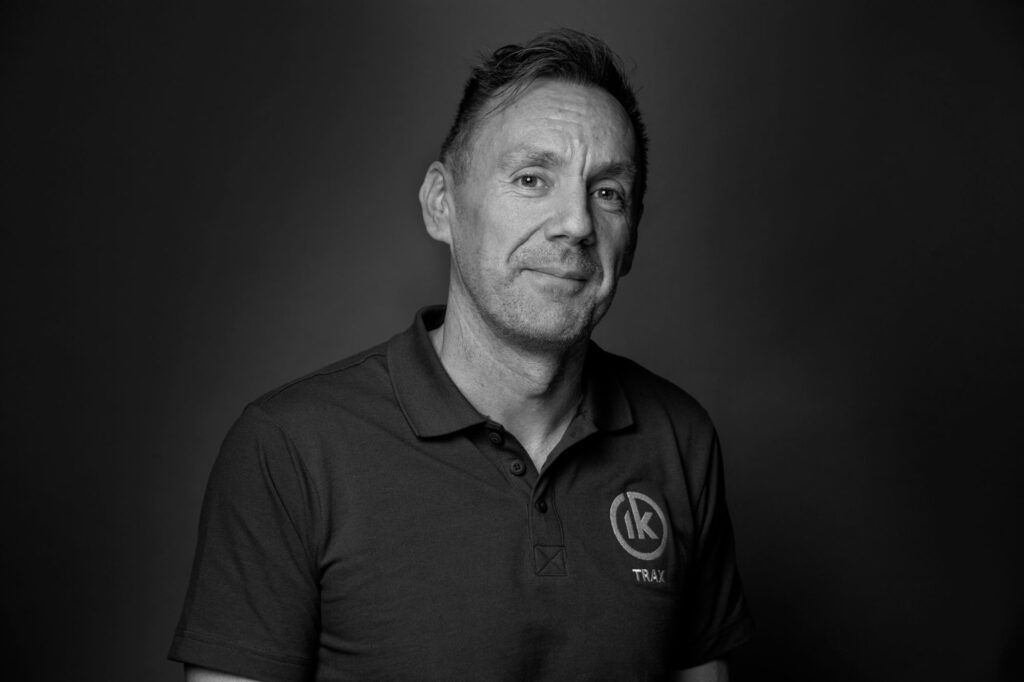
Ian McGregor was recently promoted to Production Manager at IK Trax. We caught up with him to find out more about his new role and what a typical day looks like leading the Production Team.
Tell me a bit about yourself.
I’m Ian McGregor, Production Manager at IK Trax, based in Aberdeen. I oversee production, procurement, and the logistics departments. My job is to streamline everything, reduce obstacles, particularly for the technicians and make sure that production goes as smoothly as possible. Outside of work, I like going to the gym, I like rugby (a lot!) and I enjoy going for walks in the hills. Anything that involves being outdoors.
You have been at IK Trax for several years now and dipped your toe into different departments. Can you explain how you ended up in your current role?
I was a chef before I started at IK Trax and decided that I would like to go into electronics. I went to college and that’s where I first saw the advertised Electronics Technician role at IK Trax and that is where I started in 2007. After a few years, I moved into the R&D Department whilst studying night classes at university. I also did Technical Sales spending time in Australia setting up a regional office. After some time away from the company, I returned in 2019 in Hire & Service before moving into my current role.
I feel that my experience in multiple departments has its benefits. I have seen how other departments operate and I know what is involved. It can be easy for people to focus only on what is going on in their team and, especially in this role, I can help people see the bigger picture.
Is there such a thing as a typical day for you? What does that look like?
A typical day is very busy! My days are varied so I wouldn’t say there is such a thing as a typical day. I spent a lot of time ensuring that our processes and work instructions are streamlined so that we can ensure we are able to build products efficiently. I check in with Procurement and Logistics to ensure we have all the parts we need, and we can get orders shipped on time.
I also help with technical questions whether from our technicians or customers and I am involved in training and mentoring our new technicians and apprentices.
So there are a lot of things going on – every day is different but the main focus is always ensuring we have a smooth build process and we don’t experience delays.
What would you say is the biggest challenge for you?
I think the biggest challenge is ensuring that everything is lined up so that we can meet our customers’ targets and requirements as that is the most important thing. There are numerous aspects to this such as build times, delivery of parts, relationships with suppliers, managing customer expectations etc all whilst trying to minimse costs. Communication and openness between all departments is the key to managing this.
What do you enjoy most about your role and working at IK Trax?
I think variety is the main thing. I like problems and problem solving, both in electronics and in day-to-day aspects of this role. Customers come to us with specific requirements, and I like thinking outside the box and being a bit creative to help come up with a solution for them. I’m glad I have been able to maintain that hands-on approach.
Tracking and locating are crucial activities during pipeline pigging to ensure the pig’s location and progress through the pipeline. Pig Tracking and locating allow you to do the following:
Confirm a stationary pig is or is not at the expected location e.g launcher or receiver.
Locate a stationary pig at an unknown location.
Confirm the passage of a moving pig at a particular location.
The terms “pig tracking” and “pig locating” tend to be used interchangeably – for the context of this post we will use “pig tracking” for both operations and we will be exclusively discussing Electromagnetic (EM) Technology.
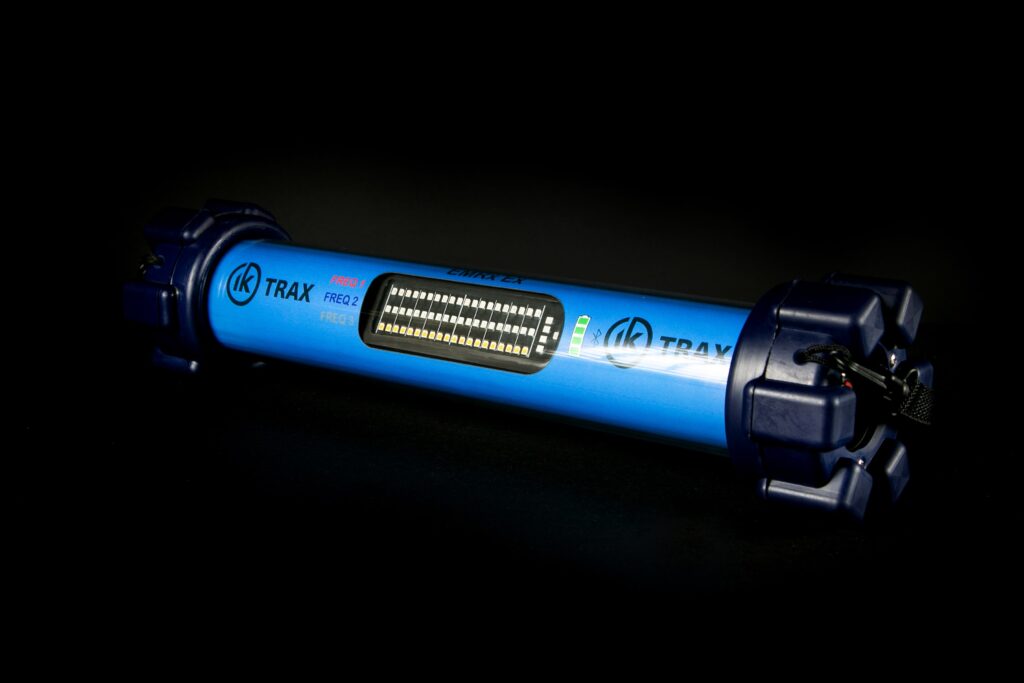
The EM transmitter null spot allows for precise locating, enhancing your confidence regarding pig location and eliminating time and costs associated with locating a stalled pig. EM systems are extremely versatile and can be used onshore, topside, or subsea with pipelines carrying liquid or gas and in trenched and pipe-in-pipe lines. They are suitable for almost every application. However, depending on the pipeline specification and the environment, challenges can arise.
1. Pipeline Depth and Wall Thickness
Pipeline depth and wall thickness are both factors that can affect the received signal strength of an EM transmitter.
Pipelines are often buried for several reasons such as to reduce the risk of third-party damage. However, the deeper the pipeline is buried, the harder it becomes to receive a signal from any tracking device fitted to the pig.
Heavy wall* pipes are often used to overcome technical challenges such as high pressure and temperature or use in deepwater applications. A heavier wall provides a greater barrier for EM signals to pass through, resulting in signal attenuation.
There are adjustments you can make to the equipment. For example, you can increase the gain on the EM receiver but this could lead to a poor signal-to-noise ratio – it is important to balance the sensitivity with accuracy of detection. Alternatively, you can increase the signal strength of the transmitter which sounds like an easy solution, but this will reduce battery life. Therefore, it is important to be aware of the length of your operation and how long you require a signal to be transmitted.
At present, the most reliable way to tell if a reliable signal will be received is to carry out representative testing under simulated project conditions.
*For the purpose of this article we discuss carbon steel only. Stainless steel signal attenuation is substantially less.
2. Pig Design
When it comes to pig design, it is crucial to find the right balance: selecting the most suitable design for the task is one aspect. On the other hand, choosing the correct EM transmitter and mounting it to the pig in a way that optimizes signal can pose challenges.
IK Trax recommend that as large a transmitter as possible is selected.
This is because a larger transmitter is fitted with more batteries – this can be used to increase signal lifespan or signal strength – maximizing flexibility in the respect that it makes pig tracking easier.
We can also provide guidance on mounting best practices such as the following:
Reducing the amount of magnetic material surrounding the transmitter. 316 Stainless steel pig bodies provide a good balance of properties and cost.
Adding slits to the body will help increase signal.
Leave as much of the transmitter exposed as possible, where practicable
The transmitter must be clamped to ensure no movement or vibration occurs as this could lead to damage.
We can work directly with customers and pig manufacturers to advise and ensure that the pig design does not compromise the performance of the transmitter and vice versa.
3. Small Diameter Pipelines
There are occasions when despite collaboration and communication between the customer, pig manufacturer and pig tracking supplier, fitting a transmitter to a standard pig is just not possible. This is quite often the case when dealing with smaller pipelines of around 4” to 6” and the transmitter is too large to fit inside the pig body. The temptation here could be to proceed without a transmitter and rely only on pig signallers or have no method of detection and hope that everything goes to plan…
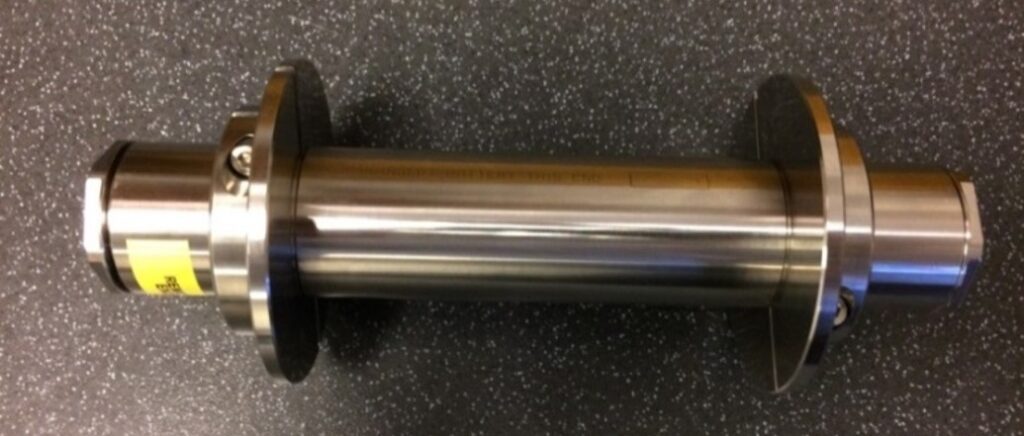
The third option (and the one that ensures you sleep better at night) is to adapt the transmitter by fitting pig discs, effectively transforming the transmitter into the pig body. As well as overcoming the issue of lack of space, this design has the added bonus of increasing the signal as it no longer needs to propagate through the pig body in addition to the pipe wall.
4. Stuck pig – now what?
Finally, the biggest challenge of all – what happens if my pig gets stuck? A pig tracking system is often considered an insurance policy – it is there for peace of mind – but as we often experience in the “real world”, sometimes you just have to use it!
The implications of a stuck pig can be significant. It can halt operations and cause potential delays in product delivery. Retrieving a lost or stuck pig can be expensive and there are the additional costs associated with downtime and disruptions.
By following the recommendations provide earlier in this article, you increase your chance of a signal being detected but how do you increase the speed of detection to minimize these costs?
Firstly, you want to be able to narrow down the search area. This can be done by placing non-intrusive pig signallers at set distances and/or at pipeline features such as valve stations. They are fitted downstream of the valve so the operator knows that valve can be closed if needed.
You can also reduce the length of search area by tracking the pig as it moves using a method called “leapfrogging” whereby an operator travels ahead of the rest of the team to the next location, ready to detect the pig as it passes.
Secondly, you will want to know the range of your transmitter, also known as the detection envelope. The detection envelope is the standoff distance from the pipeline combined with the distance upstream and downstream of the transmitter.
To find a stalled pig, you would typically move along a pipeline, pausing at regular intervals to attempt signal detection. Without knowing the detection envelope of your transmitter, you run the risk of missing the signal (larger steps) or taking longer than is necessary (smaller steps). The optimum step size is roughly half the width of the detectable envelope which should help you not only locate the pig but also do so in a relatively short timeframe.
Conclusion
Electromagnetic (EM) pig tracking is vital for pipeline operations. While EM technology is versatile and accurate, it faces challenges like pipeline depth, wall thickness, and pig design. The potential of a pig getting stuck emphasizes the need for effective tracking to prevent costly delays. By addressing these challenges through equipment adjustments and effective strategies, setbacks can be minimized and pipelines can operate more efficiently.
This website uses cookies so that we can provide you with the best user experience possible. Cookie information is stored in your browser and performs functions such as recognising you when you return to our website and helping our team to understand which sections of the website you find most interesting and useful.
Strictly Necessary Cookies
Strictly Necessary Cookie should be enabled at all times so that we can save your preferences for cookie settings.
If you disable this cookie, we will not be able to save your preferences. This means that every time you visit this website you will need to enable or disable cookies again.
3rd Party Cookies
This website uses Google Analytics to collect anonymous information such as the number of visitors to the site, and the most popular pages.
Keeping this cookie enabled helps us to improve our website.
Please enable Strictly Necessary Cookies first so that we can save your preferences!