Posts Tagged ‘Pipeline Operations’

Pig Signaller Buyer Guide – Choosing the Right Technology for Your Pipeline

Posted on: March 25th, 2026 by Carey Aiken

In pipeline operations, selecting the right pig signaller is essential for safe, efficient and reliable pigging.  While datasheets outline technical specifications, real-world conditions often demand a more nuanced approach.  Over-standardising or selecting technology solely on an outdated specification can result in poor performance, missed detections, or unnecessary operational risk.

This Buyer’s Guide breaks down the three primary pig signaller technologies – magnetic, ultrasonic and acoustic – and explains how each performs in practice, helping you identify the most suitable solution for your pipeline.

Understanding the Three Main Technologies

Magnetic Pig Signallers – Reliable, Targeted Detection Across Multiple Pig Types

Magnetic pig signallers detect changes in magnetic field as a pig carrying magnets passes the sensor.  Because magnets can be installed onto most pig types, magnetic detection is one of the most flexible and widely applicable technologies available.

This approach is straightforward, highly dependable and offers a clear, unambiguous trigger signal that is not influenced by pipeline noise or vibration.  The cost of adding magnets is comparatively low, making magnetic detection easy to adopt in most operations.  
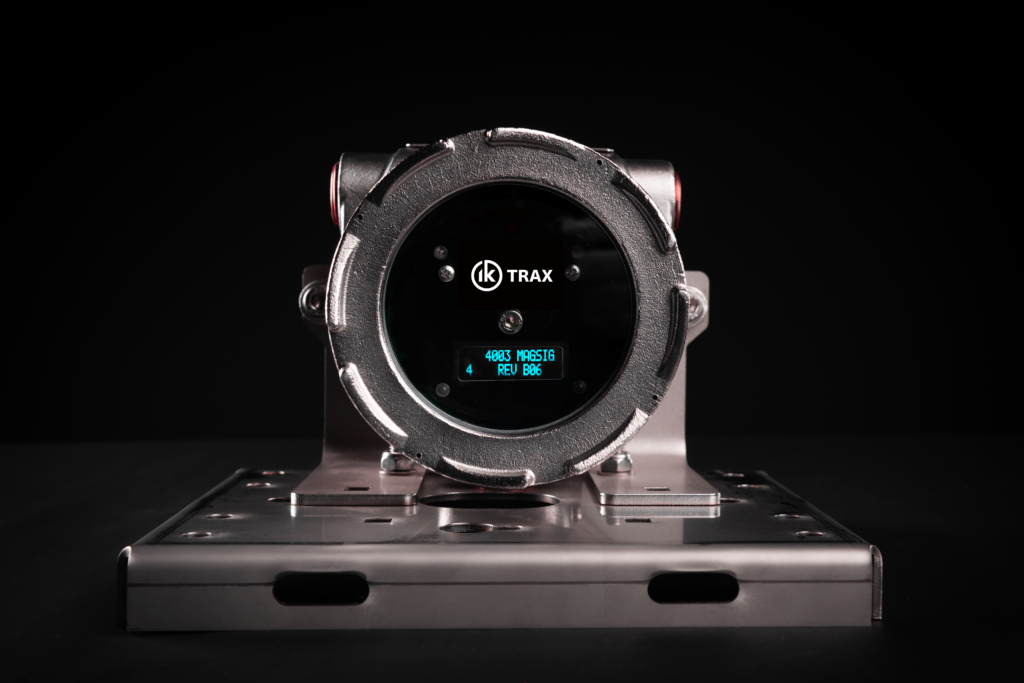
Magnetic Pig Signaller

Strengths

  • Works with a wide variety of pig types once fitted with magnets (foam pigs, polyurethane pigs, spheres, bi-directional pigs etc)
  •  Low false-positive rate, thanks to detection based on magnetic field rather than acoustic or vibration signatures.
  • Simple, robust and low-maintenance, with excellent on-site reliability.
  • Suitable for both liquid and gas pipelines, making it a versatile choice across many operating environments.
  • Cost-effective for routine cleaning, batching, dewatering and general maintenance pigging.

Considerations

  • Magnets must be fitted to the pig – either during manufacture or retrofitted later.

Ultrasonic Pig Signallers – Versatile Detection in Liquid-Filled Pipelines

Ultrasonic pig signallers required a liquid-filled pipeline to operate effectively.  They  work by transmitting pulses through the pipe wall and detecting changes when a pig interrupts the signal path.  They can detect any pig type, making them a strong choice for systems that use a variety of cleaning or speciality tools.
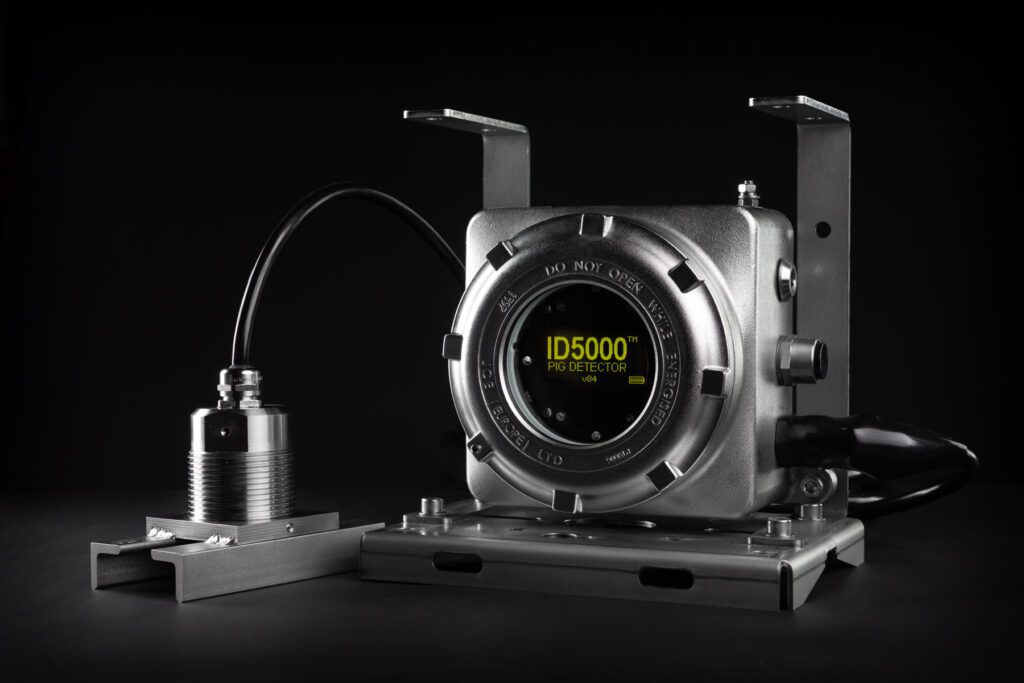
ID5000A Ultrasonic Pig Signaller

Strengths

  • Suitable for all pig types in liquid systems.
  • Highly versatile.
  • Can assist with identifying or confirming the location of stationary pigs.
  • Effective in operations requiring adaptable detection using a variety of pig types.

Considerations

  • Only effective in liquid-filled pipelines; not suited for gas systems.
  • Requires correct installation and good coupling to ensure accurate detection.
  • Performance can vary if the line has inconsistent liquid fill or large debris.
  • May require more precise setup than magnetic systems.

Acoustic Pig Signallers – Flexible Detection Based on Pig-Generated Noise

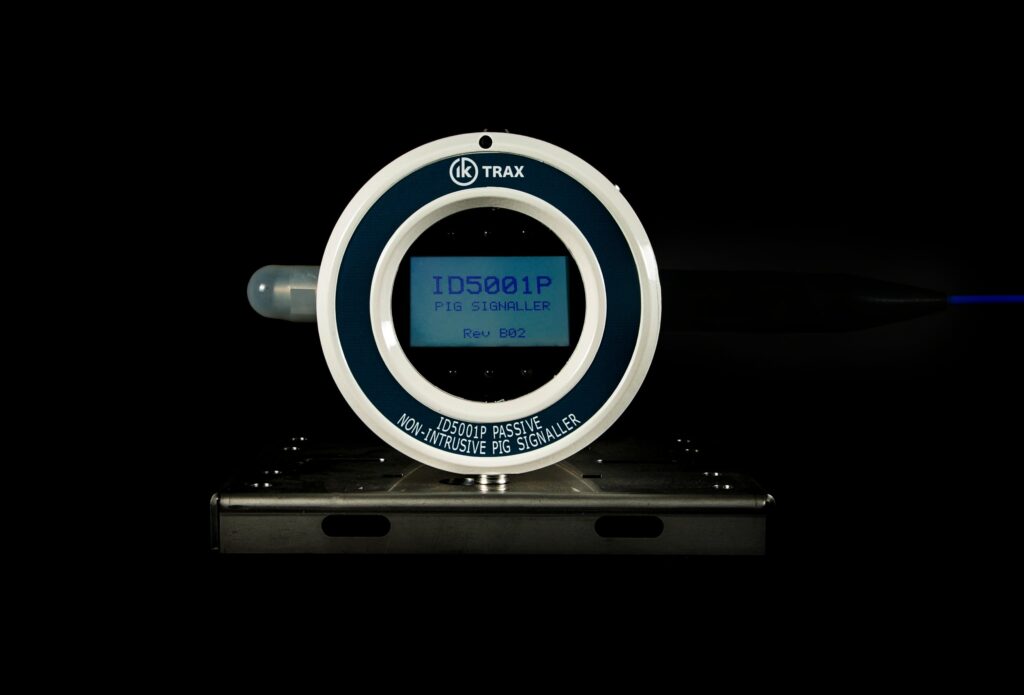
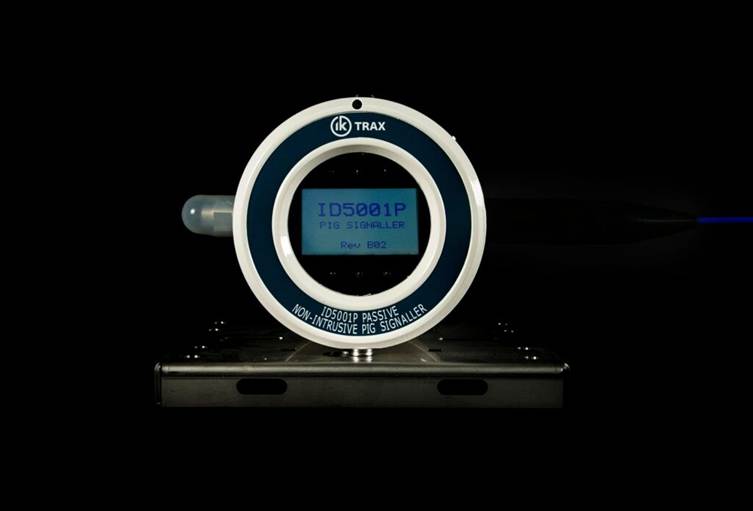
Acoustic pig signallers detect the characteristic sound signature produced as a pig moves through the pipeline.  This method does not rely on magnets or additional equipment, making it practical where pig modification is not desirable or possible. Acoustic signallers are especially effective when pigs generate a strong, distinct noise profile, such as solid polyurethane or bi-directional pigs.
Strengths

  • No pig modification required – works without magnets or transmitters
  • Useful in non-liquid pipelines and situations where magnetic is not a practical solution

Considerations

  • Due to different types of pigs producing different levels of noise, the system often needs to be calibrated for the individual pig to ensure reliable detection
  • Background pipeline noise (valves, vibration) may cause false positives
  • Quieter pigs may not produce a detectable sound profile
  • Not always ideal in locations with heavy mechanical interference

Summary of Non‑Intrusive Pig Signaller Types:
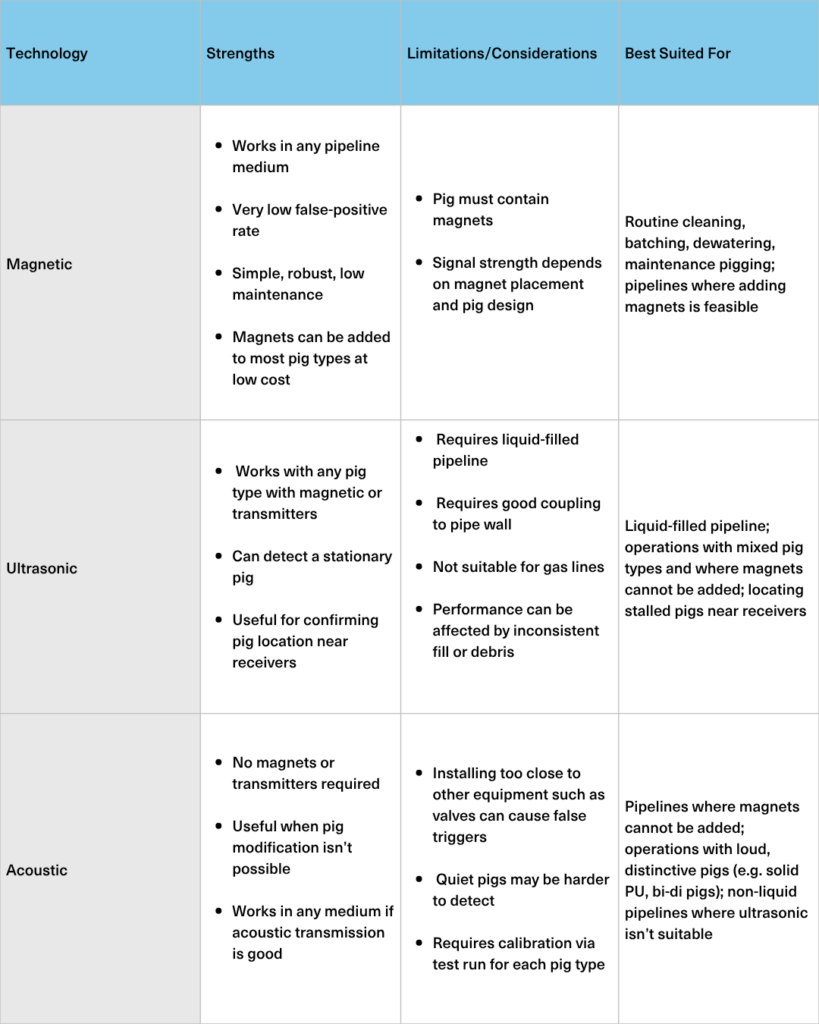
Standardisation vs Real-World Conditions

In many projects – especially larger CAPEX developments – there is a preference to standardise equipment across assets or entire facilities.  While this approach can simplify procurement, it doesn’t always reflect the reality of how different pipelines operate.

Pig signaller performance is influenced by factors such as:

  • Pig type
  • Pipeline medium
  • The level of background noise or vibration
  • Whether the pig can carry magnets

Because these conditions vary from line to line, one technology may perform perfectly in one location but struggle in another.  Relying on a single “default” signaller type can therefore lead to missed detection or reduced reliability in situations it wasn’t designed for.

A better approach is to treat standardisation as a starting point – and then adjust the chosen technology where real-world conditions justify it.  This ensures each pipeline gets a pig signaller suited to its actual operating environment, pigging practices and detection needs.

The below flow chart can be used to determine the most suitable signaller type for your application.  For further guidance, please contact the IK Trax team.
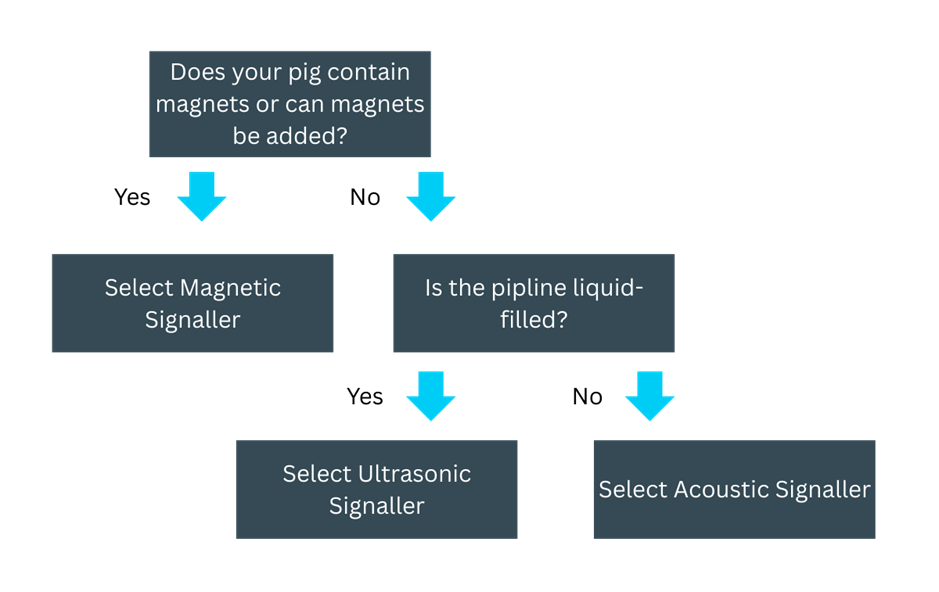
Pig Signaller Determination Flow Chart

Conclusion

Choosing the right pig signaller depends on the pig type, the pipeline medium and the operational environment.  Each technology has its strengths, but real-world conditions often determine which option will provide the most reliable performance.  Reviewing these factors early in the planning stage helps ensure the signaller selected is truly suited to the line.

For a broader overview of non-intrusive signallers, including safety considerations and communication options see our Complete Guide to Non-Intrusive Pig Signallers (2026.)
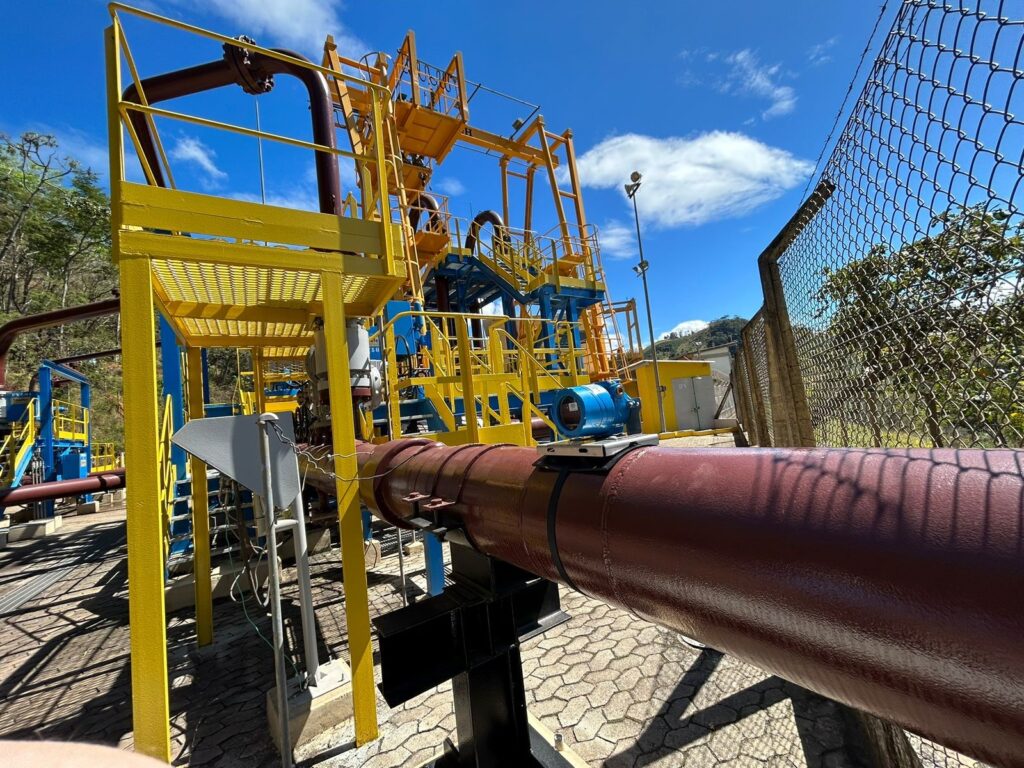

How Non-Intrusive Pig Signallers Work – A Deep Dive

Posted on: January 21st, 2026 by Carey Aiken

Non-intrusive pig signallers detect the passage of a pig using sensors mounted on the outside of the pipeline.  Unlike intrusive models, they do not penetrate the pipe wall or rely on the mechanical triggers.  This article explains the operating principles behind the main non-intrusive detection technologies – magnetic, ultrasonic and acoustic – and outlines how each method identifies a pig as it passes key points along a pipeline.

What Is A Pig Signaller?

A pig signaller, sometimes called a pig detector, is a device used to confirm that a pig has passed a specific point on a pipeline.  While “signallers” and “detector” are often used interchangeably, both terms describe equipment designed to identify a pig’s movement and indicates its passage.  Signallers are commonly installed at launchers, receivers and critical points along the pipeline to support safe and efficient pigging operations.  When a pig is known to have passed one signaller but not the next, the search area can be narrowed quickly before tracking equipment is deployed.

There are two types of pig signallers:

  • Intrusive – use a mechanical trigger inside the pipeline
  • Non-intrusive – use external sensing technologies to detect the pig without intruding into the pipe.

This article focuses exclusively on how non-intrusive signallers work.

Technology Overview

Before diving into the many smart features and benefits of non-intrusive signallers, we will outline the different technologies available and their application.

Magnetic

Magnetic pig signallers are not a new technology but they have evolved to become more reliable, configurable and easier to use.  The work across any pipeline medium – the only requirement is that the pig carries magnetics.

4003 Magnetic Pig Signaller in Operation

Magnetic Sensor: A magnetic sensor – either integrated into the unit or supplied on a cale for buried lines or limited-access locations – monitors the change in magnetic field strength as the pig approaches.  When the field reaches a pre-set threshold, the signaller registers “Approach.”

Pig Detection: As the pig passes the signaller and continues along the pipeline, the magnetic field drops.  This change is used to confirm “Pig Passage.”

Detection Alert: Once passage is detected, the signaller activates an alert.  This may be a local visual indication (e.g LEDs), and/or a remote signal to a control room or handheld device.  The event is also logged with date and time for later review.

Reset and Readiness:  After signalling, the unit resets automatically after a pre-determined interval so it is ready for the next pig.  If preferred, it can also be reset manually via the push button or from the control system.

The sensitivity to magnetic field changes deliver clear, timely indications which is why magnetic signallers remain a preferred choice for many operators.  As an additional note, the cost of adding magnets to a pig is comparatively low, so where pig design allows, magnetising the pig is generally recommend to enable this simple and robust detection method to be used.

Magnetic Pig Detector

Ultrasonic

Ultrasonic pig signallers offer a sophisticated approach to pig detection and have the added advantage of being able to detect the position of a stationary pig, not just the passage of a moving one.  They also do not require magnets or transmitters on the pig to operate.

ID000A Ultrasonic Pig Signaller in Operation

Ultrasonic Pulse Emission: The signaller is equipped with an ultrasonic transducer, supplied on a cable, and uses the pulse-echo method to monitor the time of flight of ultrasonic pulses through the pipe.  When the unit is first switched on, it establishes a baseline internal diameter for the pipeline from the returned signal.  Provided the line is liquid-filled, the device can “see” a stable reaction from the opposite side of the pipe.  

Interruption and Detection: When a pig passes the sensor location, it disturbs the flow path and breaks the beam.  This interruption changes the apparent diameter reading relative to the baseline the unit established at start-up.  The device processes this change to confirm pig passage.

Filtering: The detection algorithm can be calibrated to filter out smaller disturbances – such as debris – ensuring that only meaningful changes in the ultrasonic path trigger a pig-passage event.

Detection Alert: As with the magnetic pig signallers, ultrasonic signallers have the capability to locally or remotely signal pig passage and log pig passage data

Ultrasonic Locating: As pigs approach receivers, they can lose momentum and stall after the main line tee but before the isolation valve.  To determine the location of the pig, the operator moves the ultrasonic sensor incrementally along the pipe and monitors the live diameter reading: where the pig occupies the bore, the measured diameter deviates from the baseline; where the bore is clear, the reading returns to baseline.  In this way, the operator can map sections of the pig (e.g cups/discs vs gaps) and pinpoint the exact stall position, avoiding unnecessary delays.

Non-Intrusive Acoustic Pig Detector

Acoustic

Acoustic pig signallers operate on the principle of sound detection and can be used in any pipeline medium without the need for magnets or transmitters.  Here is a breakdown of how they function:

ID5001P Acoustic Pig Signaller in Operation

Sound Detection: Acoustic Pig Signallers monitor the vibrational and acoustic noise generated as a pig moves through the pipeline. Each pig produces a characteristic acoustic signature and the device listens for these changes at the sensor location.

Filtering and Processing: To avoid false alarms, the detection algorithm filters out background noise and focuses on the sound associated with pig movement.  Correct placement is important – these units should not be installed close to valves, pumps or other features that may create similar noise profiles to a passing pig.  A short test run is required during installation to calibrate the unit to the specific pig type and to confirm the chosen location provides clear, reliable detection.  

Alert Activation: Once the device identifies the sound of a pig approaching, it will signal “Pig Approach.”  Once the pig passes the detector and the sound level drops below the threshold, it will signal “Pig Passage.” This indication can be viewed locally or remotely.

System Reset: After a successful detection and alert, the signaller resets to its default state so it is ready for the next detection.     

Non-Intrusive Pig Detector using ultrasonic technology

Magnetic, ultrasonic and acoustic signallers work by detecting distinct physical effects at the pipe wall.  Knowing how each method generate and validates an indication helps operators install, calibrate and interpret results correctly. 

For wider context and selection guidance, see our Complete Guide to Non-Intrusive Pig Signallers (2026) and Pig Signaller Buyer Guide – Choosing the Right Technology for Your Pipeline